

Video Marketing Statistics Worth Looking At For Online Success in 2026
Did you scroll through YouTube, Instagram, or TikTok today? If you say no, you’re probably bluffing, because many of us find ourselves watching viral videos even before breakfast.
It highlights how video content has truly become the dominant force to sell or spread a message online. And when you look at the video marketing statistics, the proof is in the pudding.
And this primarily comes down to the fact that roughly 65% of people are visual learners. So, it’s no surprise that up to 91% of businesses in 2026 depend on videos as a key marketing tool.
In this article, we’ll explore the latest video marketing statistics and dissect the impact video content has on engagement, trust, revenue, and how AI platforms like Pollo AI fit into all this.
TL;DR
Video content is now a major driver for online consumers, driving 1200% more shares than other forms of media across socials, particularly with short-form videos. Brands and marketers must now adapt by meeting people where they are, hence why there’s a 25% YoY increase in video ad spend budgets. This also explains why 63% of video marketers already adopt AI tools to scale their campaigns and remain competitive.
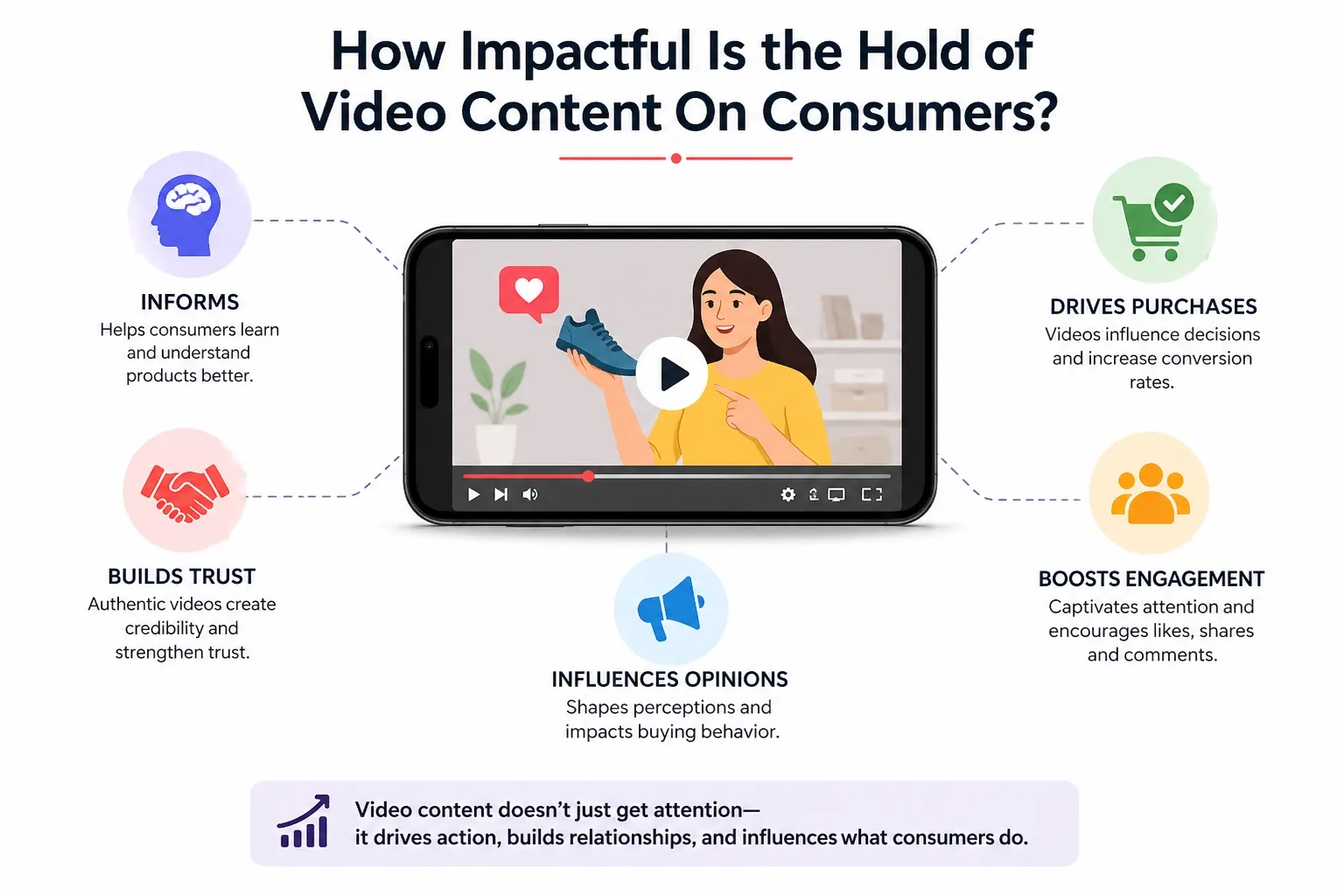
#1: How Impactful Is the Hold of Video Content On Consumers?
Are you familiar with the phrase, doom scrolling? Well, it’s become the digital equivalent of a viral plague, keeping us completely glued to our screens. It’s totally nuts, right?
Well, from 2018 to 2023, the time users spent watching online videos rose from 10 to 17 hours per week, with around 75% of that content viewed on mobile devices.
Ever since platforms like TikTok, YouTube, and Instagram began to focus on vertical messaging, it has become so easy for us to consume videos, especially on the go.
And it is this combination of social media and visual content that has reshaped digital behavior dramatically. In the past, we were open to taking the time to explore for information online.
Now, most of us want it delivered right away because we are constantly facing information overload. There’s too much to sift through, and we no longer have the attention spans to wait.
This led to social platforms pushing us towards more video-based messaging. And it didn’t take long for us to begin favoring fast, punchy, and immersive formats over longer videos.
After all, Instagram Reels, YouTube Shorts, and TikToks are easier to watch and swipe through, right? Because of this, they can achieve up to 2.5 times the engagement of long-form videos.
Video Content Data Breakdown per Social Platform
| Social Platform | Key Metric | Key Data / Insights | What It Means |
| Instagram Reels | Platform Growth Driver | Reels heavily contributes to Instagram’s growth focus | Meta is prioritizing short-form in its algorithm |
| TikTok | Market Share | ~40% of short-form video market | Among the highest engagement across social platforms |
| YouTube Shorts | Daily Views | 80B–200B daily views | Largest user base among short-form platforms |
| Across All Platforms | Internet Traffic | ~82% of internet traffic is video (mostly short-form) | Video is now the dominant content format |
This is also why social videos generate up to 1200% more shares than other forms of media. Naturally, this demand for compelling video content also started to affect consumer preferences.
As it stands, over 73% of online users usually opt to discover products through videos. And this is further reinforced by how videos significantly impact consumer trust. Just think about it.
When most of us see a creative ad video, our perception of the product or service is often a positive one. Suddenly, what was an initial ‘maybe’ can quickly turn into a ‘definite yes’.
This is backed by the fact that roughly 87% of consumers are typically convinced to purchase after watching a video promotion.
Create Viral Videos in Just Seconds
Use Pollo AI to instantly turn your ideas into stunning, scroll-stopping videos that drive your business!
Start Creating Viral Contents Now!
#2. How Does Video Content Affect Brands & Marketers?
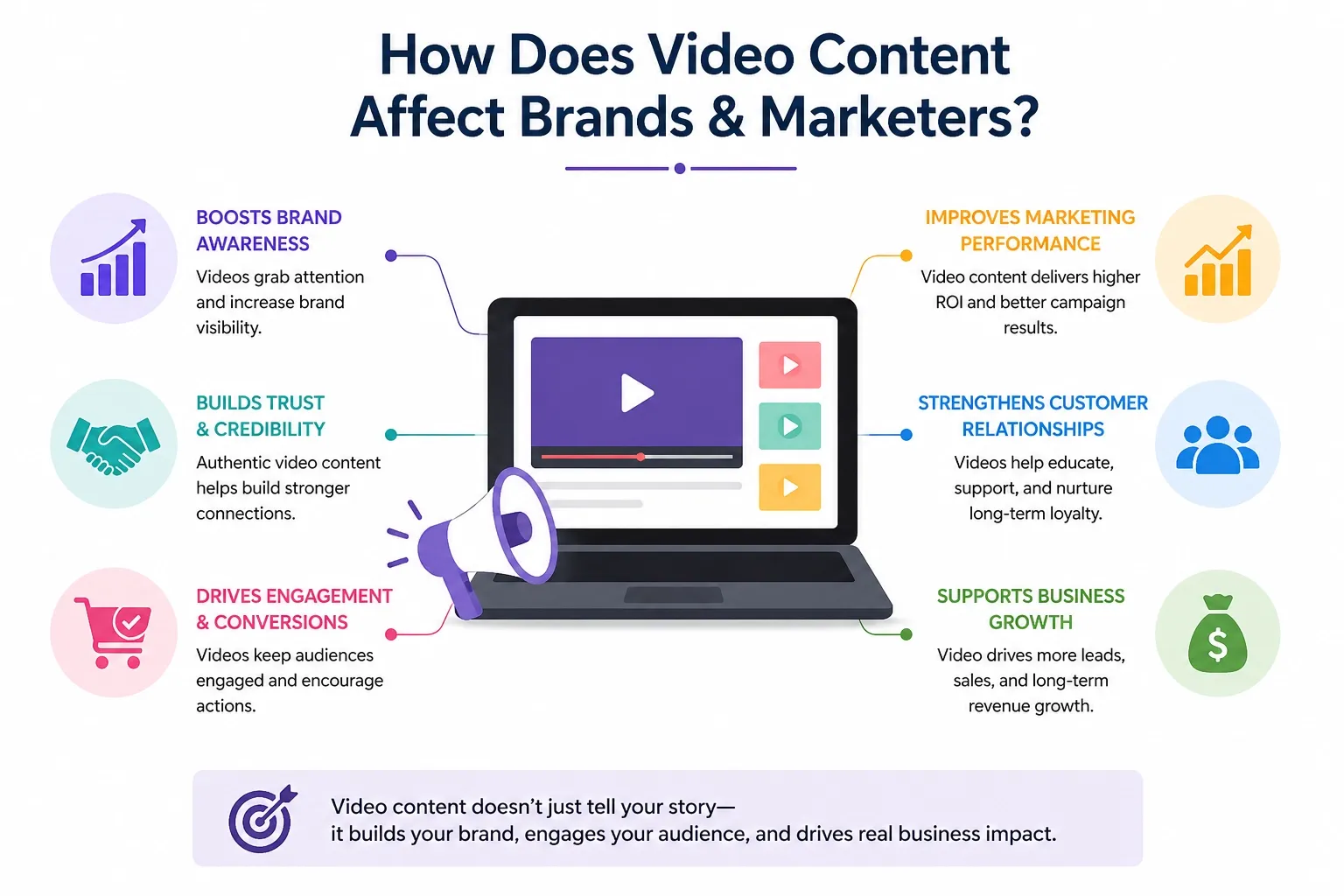
With video content commanding the attention of everyday consumers online, it wouldn’t be a stretch to say that brands and marketers must meet people where they are.
This means reaching them in video format. In other words, producing video content is no longer optional for any of us, and the video marketing statistics make that clear.
For instance, marketers who utilize video content often gain up to 66% more qualified leads each year, with most of them reporting higher visitor dwell time on their websites.
And if you didn’t know, search engines typically prioritize video content on SERPs. So, it’s no shocker that those pages typically produce up to a 41% higher CTR than plain text.
Speaking of SEO, including video content on landing pages boosts conversion rates in B2B and e-commerce sites because they build trust, offer clear value proposition, and keep visitors engaged.
What’s more? Video ads often have higher purchasing rates than static posts, and businesses that actively use video marketing see greater yearly growth in revenue.
Why? Because consumers often prefer to engage more with video content, and they typically retain information sent via video messaging better.
It’s no wonder that most marketers who have yet to use video messaging intend to do so in 2026. And those who already use video have high investment confidence in it.
In fact, roughly 41% of marketers spent more money on video ads in 2025 than in 2024. And they continue to raise their video ad spend to boost brand awareness among Gen-Z and millennials across socials.
Key Video Content Statistics To Consider for Brand Marketing
| Area | Key Stats | What It Means |
| SEO & Conversions | +80–86% higher landing page conversions | Video significantly improves user decision-making |
| Ad Performance | +47% higher purchase rates vs static ads | Video ads drive stronger buying intent |
| Revenue Growth | +49% faster revenue growth (video users) | Video accelerates overall business growth |
| Engagement | Up to 2.5× more engagement (short-form) | Video captures and holds attention better |
| Retention | ~80%+ watch rates on short videos | Users stay longer on video content |
| Ad Spend Trend | +25% YoY increase in video budgets | Marketers are doubling down on video |
| Adoption Rate | 67% of marketers plan to adopt video by 2026 | Video is becoming a standard, not optional |
What these video marketing statistics show us is that video's effectiveness at driving awareness, traffic, and conversions is hard to ignore for new and existing brands/marketers.
But this brings us to another interesting question. How do the video marketing statistics play out across various social platforms like TikTok, Instagram, YouTube, etc?
#3. How Does the Approach to Video Marketing Shift Across Different Social Platforms?
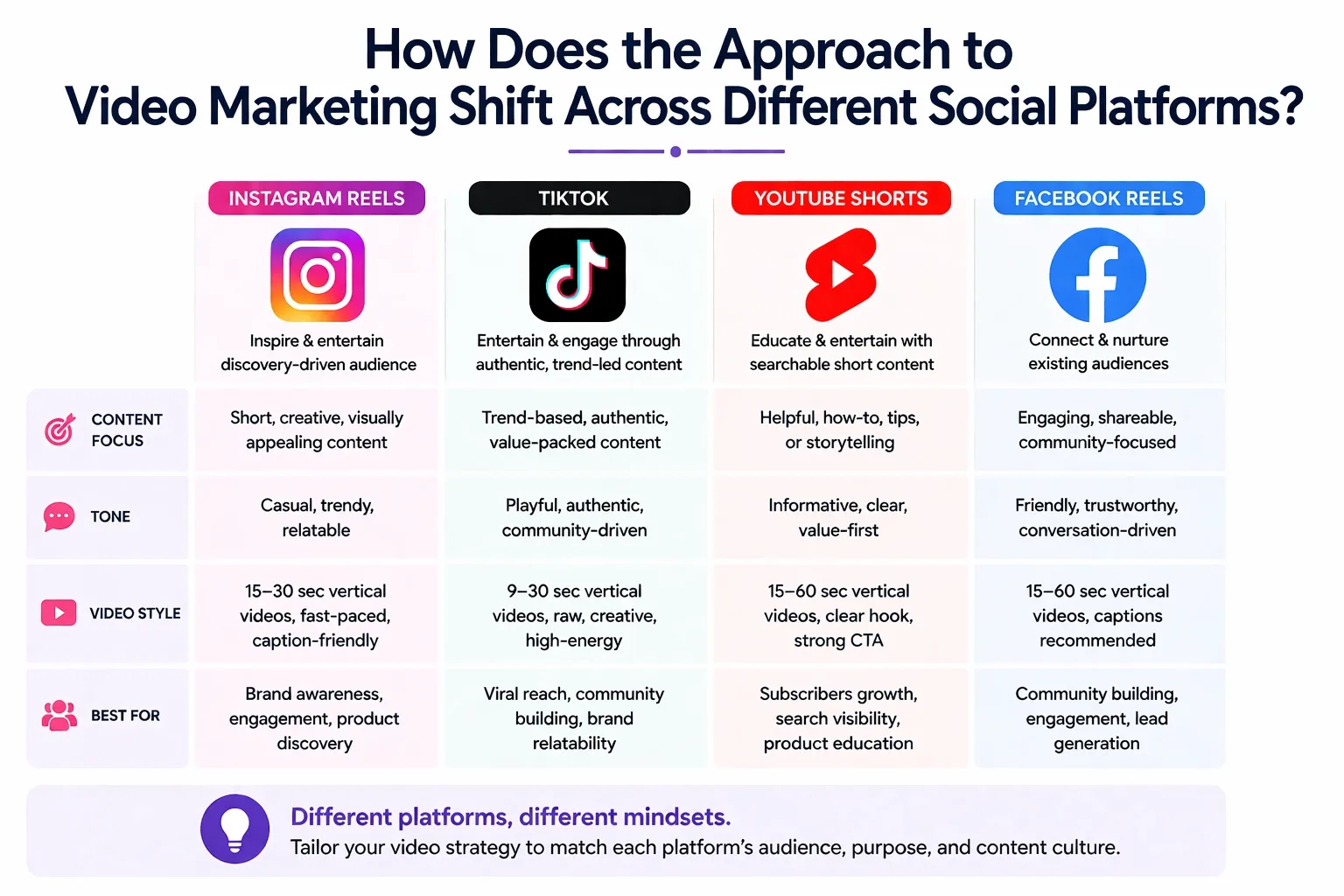
We’ve all posted videos on socials, and many of us can agree that it’s not the same all around. After all, each platform functions on a different set of rules, algorithms, demographics, etc.
If we start with the video marketing statistics of YouTube, it is the most used video platform. Around 82% of businesses lean on it to publish a mix of short and long-form video content.
Compared to other platforms, YouTube is suited for brand discovery. It appeals to consumers who are actively researching information on products, like reviews, comparisons, how-tos, etc.
But despite YouTube having the highest potential reach, around 12% of global marketers rank it as the video platform with the third-highest ROI.
Next up is Instagram, which is used by roughly 53% of video marketers. It works best for trend-driven storytelling and creating awareness via Reels.
For reaching younger audiences, it’s ideal, with roughly 70% of Instagram users actively relying on it to discover and shop for brand products online.
No surprise that it’s the second most-cited social platform for ROI. However, it has faced significant algorithm shifts, which have affected engagement rates in recent years.
When it comes to Facebook, about 28% of global marketers report that it delivers the highest ROI for retail and e-commerce.
With a more community-oriented focus that makes content highly shareable, it works well for reaching the older demographic, even with longer-form videos.
Moreover, Facebook ads boast a conversion rate that ranges between 8.9% to 9.2% on average, with some industries even climbing above 14%.
Up next is TikTok, which focuses on raw, fast-paced, short-form videos. It boasts very strong engagement of about 5.75%, which is just behind YouTube Shorts’ 5.91%.
Additionally, it boasts the highest user-to-buyer conversion rates, with TikTok shopping set at a 4.7% conversion rate, compared to Instagram shopping’s 2.1%.
However, it is exceedingly trend-driven. As any TikTok creator will testify, this platform typically requires near-perfect alignment with what’s new and viral.
How Each Social Platform Handles Video Content: A Quick Summary
| Platform | Max Video Length | Ideal Length | Algorithm Focus | Audience Reach Style | Content Style That Performs Best |
| Instagram Reels | 90 sec (up to 15 min in some cases) | 7–15 sec | Engagement (likes, shares, saves) | Follower + discovery hybrid | Aesthetic, trends, lifestyle |
| TikTok | 10 min (but short performs better) | 7–20 sec | Watch time + completion rate | Strong discovery (For You page) | Trends, storytelling, raw/relatable |
| YouTube Shorts | 60 sec | 10–30 sec | Watch time + repeat views | Discovery + subscriber push | Informative, hooks, repurposed content |
| Facebook Reels | 90 sec | 15–30 sec | Shares + engagement | Follower-based + some discovery | Viral, relatable, community-focused |
So, how is all this relevant? These video marketing statistics show us that we are all navigating a rather fragmented online landscape that doesn’t cater to generic cross-posting.
Social platforms are clearly being engineered to drive video content forward, but each one requires an adaptive and rapidly scalable approach.
Because of this, brands and marketers can’t just rely on manual efforts, or they risk falling behind in speed, cost-efficiency, etc. This is where AI video creation comes into play.
#4. Is AI Video Creation Reshaping the Frontier of Video Marketing?
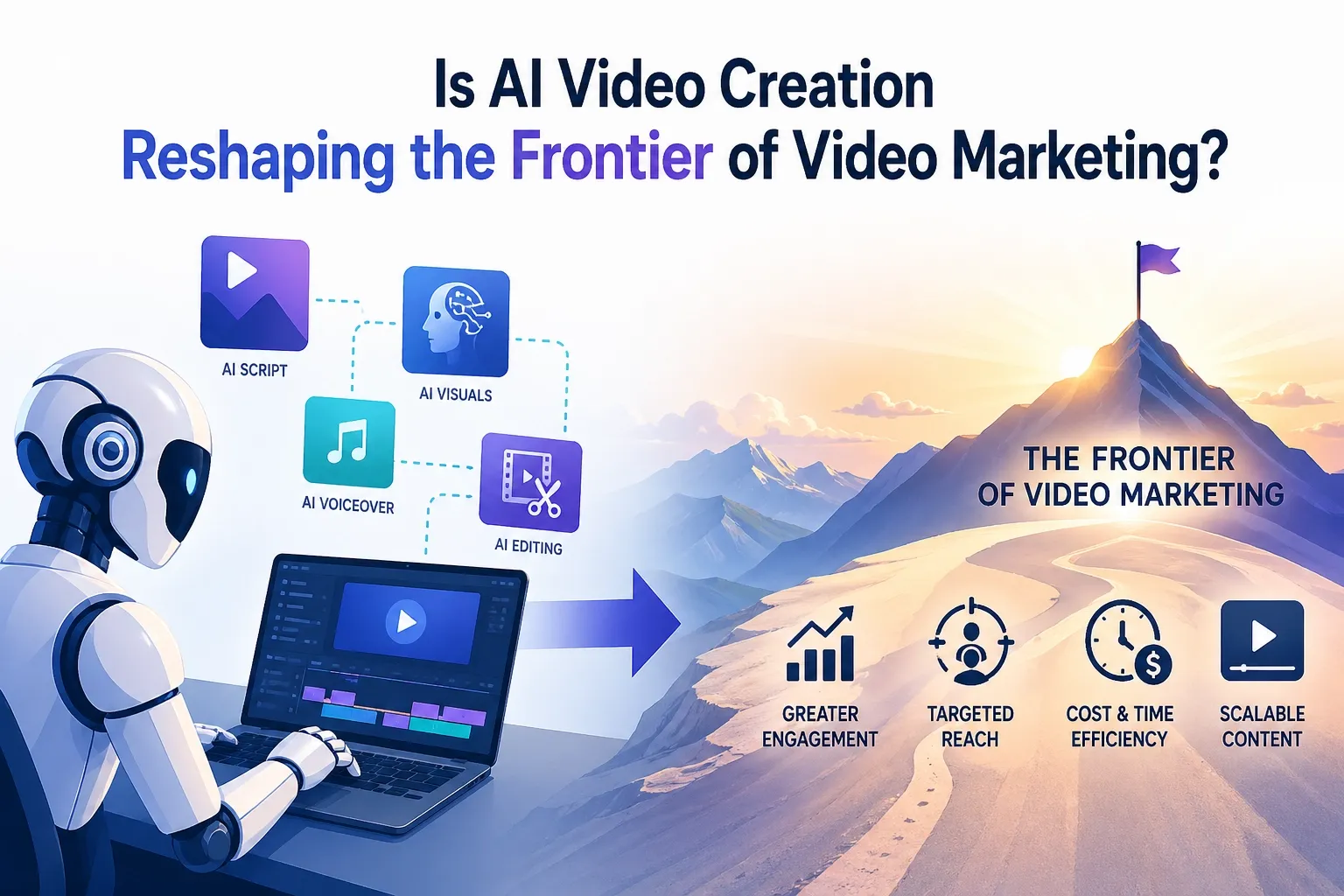
Despite the constant online debates on the authenticity of AI videos, most of us continue to see them flooding our social feeds on an almost regular basis.
Using next-gen AI platforms like Pollo AI, any of us can effortlessly create and scale creative video content in just a few clicks, even without any technical know-how required.
And many video marketers have caught on to this! Up to 63% of them report that they already rely on AI tools to produce video content, up from the 51% of video marketers in 2025.
Moreover, almost 90% of online video ad buyers are using or planning to use AI to build video ads, with many projecting Gen AI to make up 40% of all ads by 2026.
Slowly but surely, AI video is evolving. The release of powerful AI models like Kling 3.0 and Seedance 2.0 is proof that the lack of visual realism we often face will be a thing of the past.
Even before the latest advancements, we have seen brands and marketers experiment with AI to produce cinematic commercials. What’s more, many are being very creative with it.
Some popular examples include:
- Coca-Cola released a viral Christmas ad in 2024
- Popeyes created a viral (w)Rap Battle ad competing with McDonald's in 2025
- Kalshi aired an AI-generated ad during the NBA Finals 2025
We should also point out that roughly 33% to 36% of consumers are open to the idea of brands and marketers using AI videos in their campaigns.
In fact, around 69% of Fortune 500 companies, including Unilever, are already using AI video in marketing. In other words, the train has left the station.
Most of the time, we only find it problematic when it looks generic and sloppy. This is why about 96% of marketers cite that personalization is key to achieving greater ROI with AI videos.
For example, AI videos perform best when trend-aligned and captioned. You should also consider how they work well on social platforms that rate content value over visual quality.
This explains why you will often see AI videos achieving millions of views across TikTok or YouTube Shorts, compared to other platforms like Instagram.
And in most cases, some of the trending AI video formats that seem to be doing well on these socials include UGC AI avatars, faceless storytelling, horror narration, etc.
Ultimately, this shows us that brands and marketers can benefit from AI videos. And as these AI tools evolve, we can expect to see more significant shifts in how video marketing is handled.
How Can Pollo AI Elevate Your Video Marketing Game?
Need to streamline your video production? Try Pollo AI for its an all-in-one AI image and video creation platform that can help you turn any raw idea into a publish-ready final piece in minutes.
Integrated with top-tier AI video models like Seedance 2.0, Kling 3.0, and Veo 3.1, you can access text to video, image to video, and reference-to-video capabilities in one unified platform.
But the true standout feature is Pollo Agent. With this iterative, chat-based tool, you can clone trending Reels, Shorts, TikToks, and more, generate high-converting UGC ads, etc.
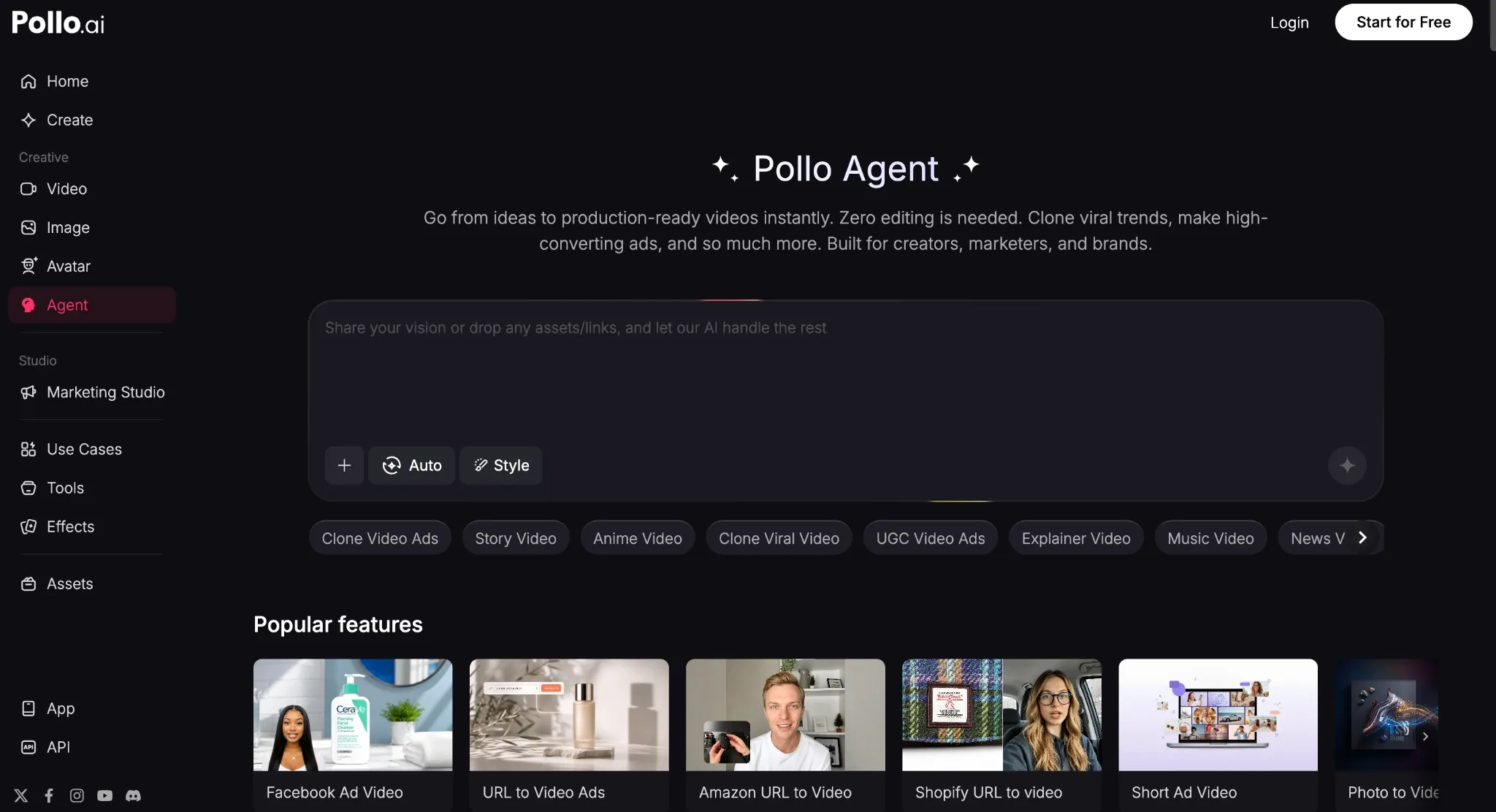
Since it keeps track of your references, edits, and visual direction, you can make all kinds of visual changes without starting over. Best part? No manual editing required.
Everything from structure to pacing to voice-overs is automated, so you can generate a polished, publish-ready video, even as a complete beginner.
Besides that, there’s Pollo AI Avatar, which lets you create UGC-style videos using lifelike avatars with natural-sounding voiceovers and perfect lip-sync.
You can also access Pollo Mimic, which lets you extract the character movements from a reference video and breathe life into any subject image by replicating that exact motion.
What’s more? There are 100+ specialized workflow apps on Pollo AI that can help you streamline video creation tasks across social media, marketing, entertainment, etc.
Feel free to test out the platform yourself at no cost via Pollo AI’s free trial plan. You’ll be surprised at just how much simpler your video marketing campaigns will become!
Conclusion
To sum it up, the video marketing statistics we’ve laid out here should show just how important video content is at connecting with consumers and converting them into paying customers.
But beyond that, it should also be clear why brands and marketers need to embrace powerful AI creation tools like Pollo AI to optimize their video marketing campaigns over the long-term.
Given how demand for engaging video content continues to heat up, it’s all about understanding the data and adapting to what the market demands for sustainable results.
FAQs
How many businesses use video marketing in 2026?
Video marketing is so essential that up to 91% of businesses in 2026 depend on it to market their products and services. In fact, companies that use video marketing see 49% faster revenue growth per year than those that don’t.
Which video format delivers the highest ROI?
Short-form video content is dominating, with most marketers ranking it as #1 for ROI. If you want to see higher engagement, then focus on producing Instagram Reels, YouTube Shorts, and TikToks rather than long-form video content.
Why should I use AI for video marketing?
Using AI video creation tools can help you reduce production costs by about 80-90%, which is why up to 63% of marketers already implement AI in their campaigns. Rather than relying on hiring influencers, scheduling shoots, and spending weeks on post-production editing, AI can help streamline it with ease.
What is Pollo AI, and how can I use it in video marketing?
Pollo AI is an all-in-one AI image and video creation platform that lets you turn raw ideas into publish-ready final pieces with no manual editing. Using standout features like Pollo Agent for cloning trending videos and Pollo AI avatar for creating UGC-style content, you can lower video production time and costs with a few clicks.
Is Pollo AI suitable for professional video marketing campaigns?
Absolutely. With access to top-tier AI video models like Seedance 2.0, Kling 3.0, and Veo 3.1, you can produce lifelike and studio-level video content for a wide range of use cases and with zero technical experience. This can be showcases, demos, explainers, testimonials, and more.