

Happy Horse 1.0 vs Seedance 2.0: Which AI Video Model Actually Wins?
Seedance 2.0 recently went viral and topped the Artificial Analysis Leaderboard. Not long after, Happy Horse 1.0 replaced it at the top and quickly drew everyone’s attention.
While Seedance 2.0 was everywhere on social media, Happy Horse 1.0 arrived quietly, which made its rise even more surprising. So which one is actually better? Let’s take a closer look.
Happy Horse 1.0 vs Seedance 2.0: Core Specs
Before we get into the Artificial Analysis rankings, let’s break down the core differences between these two leading AI video models. For quick review, here’s a simple comparison table:
| Aspects | Happy Horse 1.0 | Seedance 2.0 |
| Developer | Alibaba-ATH (Alibaba Token Hub) | ByteDance (Dreamina/Jimeng) |
| Architecture | Unified Single-Stream Transformer with 40 layers | Dual-Branch Diffusion Transformer |
| Parameter Count | ~15 Billion | Undisclosed |
| Inference Speed | 8-Step Denoising (Ultra-fast) | Standard Diffusion Steps |
| Max Resolution | Cinematic 1080p | 2K (Up to 3840×2160) |
| Native Audio | 7 languages supported with lip sync | 8+ languages supported with lip sync |
| Open Source Status | (Coming Soon) | Closed-Source / API Only |
Looking at this table, it’s clear that Happy Horse 1.0 and Seedance 2.0 take very different approaches, each with its own strengths.
Seedance 2.0 comes from ByteDance and builds on an earlier version, so it feels more like a refined continuation. In contrast, Happy Horse AI is Alibaba’s first entry in this space, and it brings a noticeably different direction to AI video generation.
The biggest difference shows up in how the models are built. Seedance 2.0 follows a diffusion-based architecture, handling audio and visual elements in separate branches. Happy Horse AI, on the other hand, uses a unified single-stream transformer, processing text, images, audio, and video all at once.
You can also see the gap in speed. Seedance 2.0 sticks with standard diffusion steps, while HappyHorse 1.0 cuts the process down to just 8 denoising steps with DMD-2 distillation, which makes generation noticeably faster.
That said, Seedance 2.0 still holds an advantage in resolution, supporting up to 2K output, while HappyHorse 1.0 is currently limited to 1080p.
With these core differences in mind, let’s see how they actually perform on the Artificial Analysis Leaderboard.
How Do Happy Horse 1.0 & Seedance 2.0 Rank?
Looking at the Artificial Analysis leaderboard, it’s based on blind testing, where users compare videos generated from the same prompt without knowing which model created them. This setup keeps the ranking focused purely on visual quality.
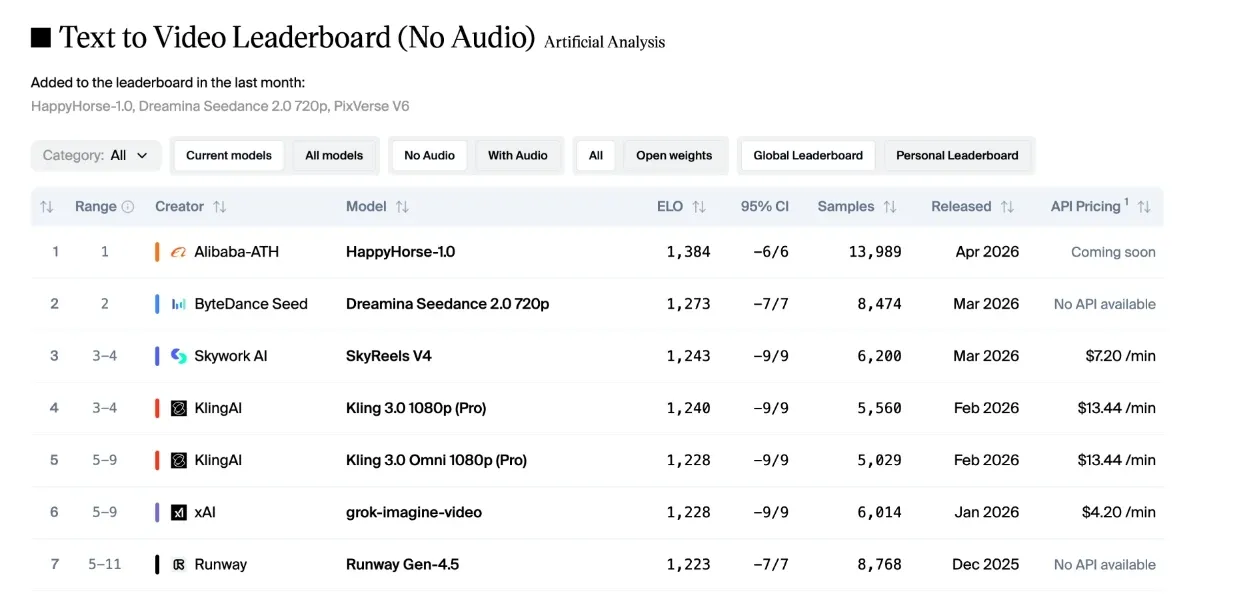
As of April 13, 2026, the results are quite telling. In the Text to Video (No Audio) category, Happy Horse 1.0 clearly takes the lead, sitting over 100 Elo points ahead of Seedance 2.0.
That kind of gap is hard to ignore. It suggests that Happy Horse 1.0 is more consistent when it comes to interpreting prompts, delivering sharper visual detail, and more natural motion overall.
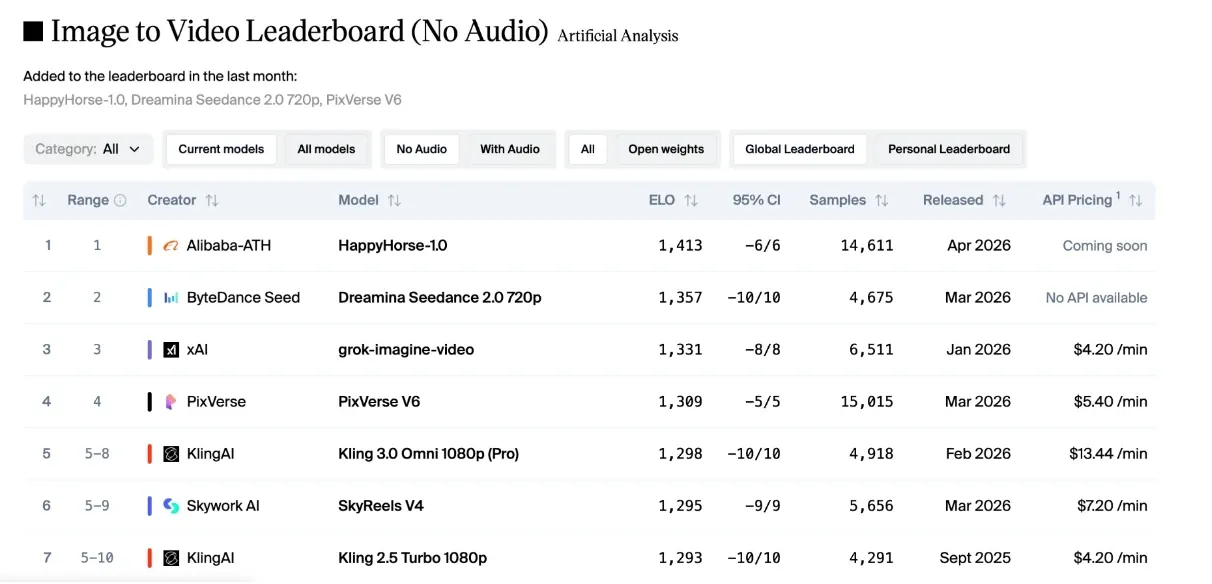
You can see the same pattern in the Image to Video (No Audio) category. Happy Horse 1.0 is still in front, holding a lead of over 50 Elo points against Seedance 2.0.
The gap is smaller this time, but the trend is consistent. It reinforces the idea that visual quality is where Happy Horse AI really stands out. Even when working from image references, it appears more reliable in maintaining subject details and style consistency.
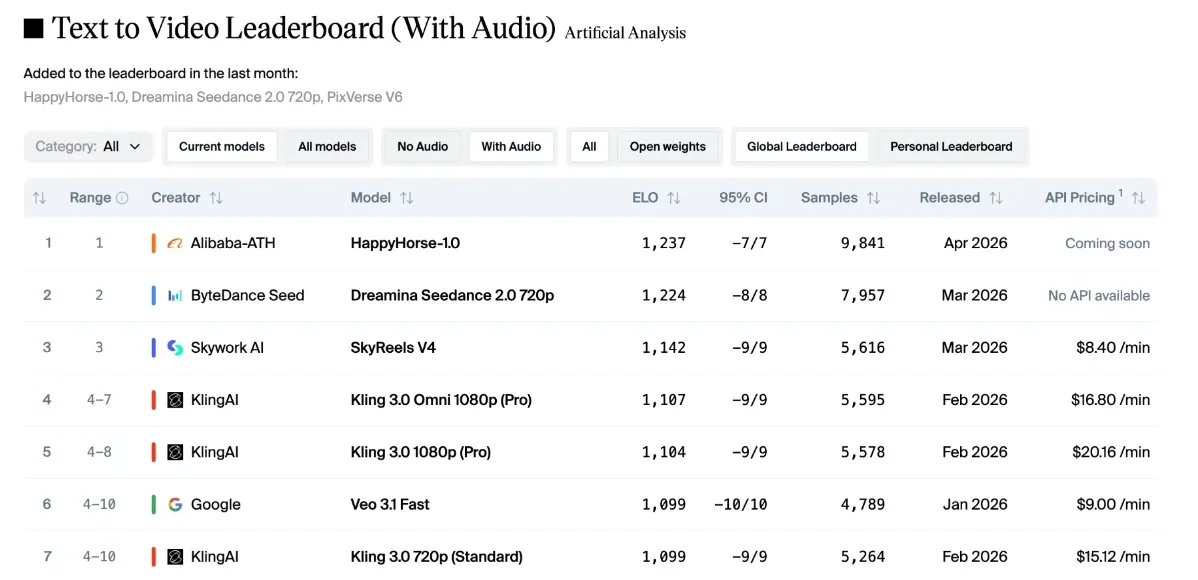
Looking at the Text to Video (With Audio) category, the gap between the two starts to narrow. Happy Horse 1.0 is still slightly ahead, but only by a small margin.
With such a close score, there’s no clear advantage on either side when audio comes into play. In practice, both models perform at a very similar level, making this category feel almost evenly matched.
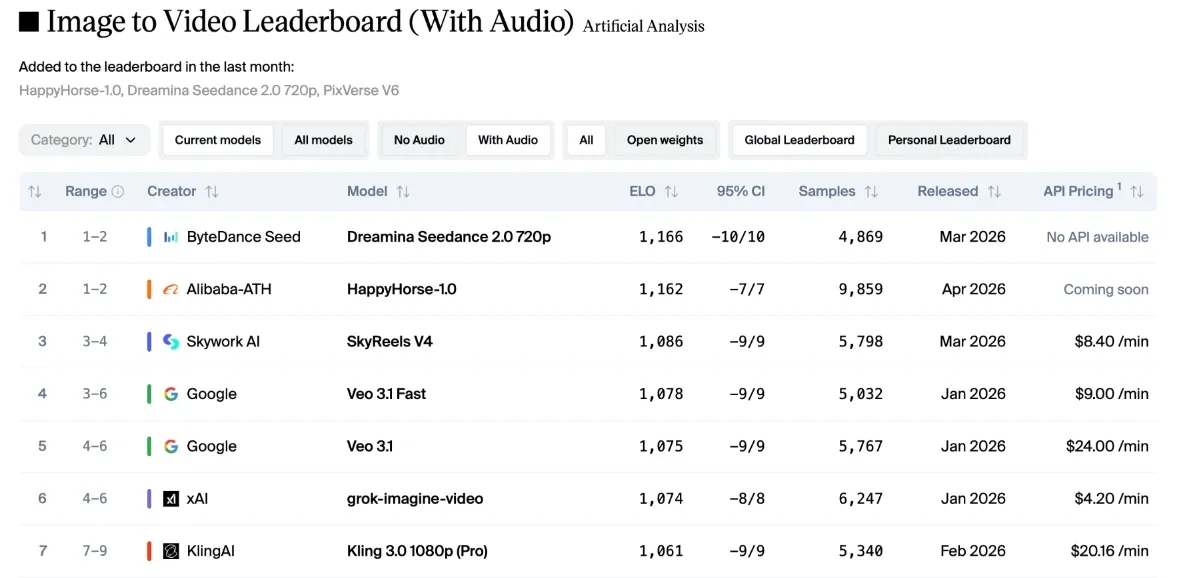
When it comes to the Image to Video (With Audio) category, Seedance 2.0 edges ahead of Happy Horse 1.0, though only by a narrow margin.
What Should You Choose: Happy Horse 1.0 or Seedance 2.0?
Right now, Seedance 2.0 feels like the more practical choice when audio is involved. The gap with Happy Horse 1.0 is small, but its broader language support and more stable voice generation make it better suited for talking avatars, multi-character scenes, and content that relies on dialogue.
Happy Horse 1.0, however, clearly pulls ahead on the visual side. It delivers sharper detail, smoother motion, and a more cinematic look overall, even in scenes with complex camera movement.
It’s also faster. That speed makes a real difference when you’re creating product shots, B-roll, or campaign visuals at scale.
So if your priority is visual quality, Happy Horse 1.0 stands out. But in terms of what you can actually use today, Seedance 2.0 is still the only available option.
Pollo AI: Turn Creative Ideas into Post-Ready Videos
If you’re comparing models like Seedance 2.0 and HappyHorse 1.0, the real question isn’t just which one performs better, but where you can actually put them to use.
Pollo AI brings these models together in one place. It’s an all-in-one platform where you can already work with models like Seedance 2.0, Kling 3.0, Wan 2.6, and many others, with HappyHorse 1.0 expected to arrive soon, often with early access or limited-time offers.
Built on top of these models, Pollo Agent takes things further by turning raw outputs into complete videos with clear pacing, structured flow, and built-in hooks.
Instead of editing clips manually, you simply start with an idea, and the system shapes everything for you into a video that feels ready to post from the start.
As more advanced models like HappyHorse 1.0 are integrated, this workflow will only become more powerful, combining stronger visual generation with fully automated video creation in one place.
If you want to start creating with Seedance 2.0 now and stay ready for HappyHorse 1.0 when it launches, Pollo AI is a natural place to begin.
Conclusion
Comparing HappyHorse 1.0 and Seedance 2.0 has been insightful, but the reality is simple: Happy Horse AI is not available yet.
Without public access or a clear release timeline, most of the discussion around it remains forward-looking.
In contrast, Seedance 2.0 is already usable today. And if you want to move beyond testing and start creating real content, you can access it directly on Pollo AI. Start creating and see what you can build with Seedance 2.0 on Pollo AI today!