

How to Optimize Your YouTube Videos for More Views: The Ultimate SEO Guide
Getting more views on your YouTube videos often comes down to algorithmic recommendations. This is what drives most of the viewership numbers on the platform.
But what most creators may fail to consider is that these recommendations are influenced by SEO, which means metadata like titles, descriptions, and tags.
These signals help YouTube’s algorithm determine the relevance, classification, and authority of any videos that it recommends to other viewers. So, how can you best optimize them?
Rather than settle for generic tips, let’s dive into actionable strategies that will actually help you boost views on YouTube. And we’ll even touch on how Pollo AI can prove helpful.
How Does YouTube SEO Impact the Algorithm?
YouTube’s algorithm largely determines how visible your videos are to others on the platform, with up to 70% of all views driven by it. Talk about control, right?
Essentially, the algorithm’s suggestions make a bigger impact on views than searches. But what few creators realize is that it also uses metadata to connect your videos with the right audience.
While it’s true that titles, descriptions, and tags are no longer primary drivers, they remain supporting elements that can impact long-term channel success on YouTube.
For instance, titles are the most important YouTube SEO element to consider. Why? Because this is how the algorithm indexes videos for search via primary keywords.
Descriptions give YouTube’s algorithm a clearer context on what your video content has to offer, so that it gets matched with the right viewers.
While tags don’t play a big role, they still help YouTube’s algorithm by providing more niche context on the video topic for even more focused audience targeting.
With all three signals, you create a metadata profile that solidifies the algorithm’s understanding of your video content. Now, let’s talk about the top strategies of optimizing YouTube SEO.
#1. Optimize Titles With CTR and Primary Keywords In Mind
Your title largely impacts the success of your video since it affects both YouTube SEO and viewer perception. After all, it is the first thing that people see alongside your thumbnail.
This means you need a YouTube video title that balances primary keywords and delivers a high click-through rate (CTR) at the same time.
To nail this, you need to identify a primary keyword on the topic with a high search volume and use it to craft a short title that sparks curiosity or presents a clear value proposition.
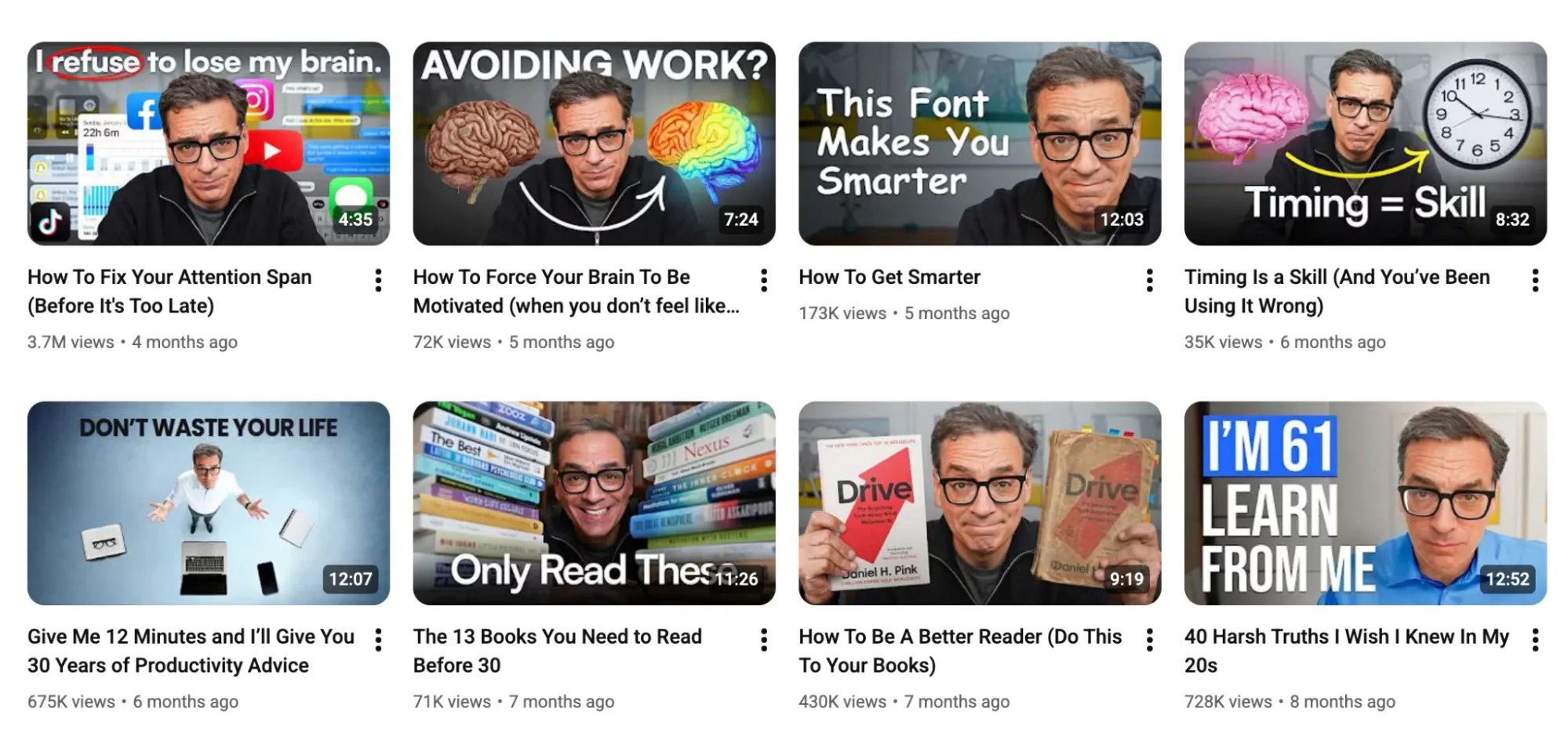
For example, creators like @DanielPink combine keywords with value propositions to create YouTube video titles that incentivize viewers to want to know more.
#2. Focus on High-Intent, Low-Competition Keywords
Instead of trying to compete for attention using broad keywords, you will be better off using keywords with a lower search volume that match audience search behaviors.
It’s a great way to optimize your video metadata because it prioritizes traffic quality over search volume. And this often leads to genuine viewer engagement and subscribers.
A good rule of thumb is to add terms like “how to”, “best way to”, etc. For example, let’s say you used Pollo AI’s tutorial video maker to create a video on YouTube views growth.
Instead of ‘Get More YouTube Views’, you can say ‘How To Grow YouTube Views for 0-1000 Subscribers’. This narrows down the viewer pool and raises your chances of ranking at the top.
#3. Craft Keyword-Rich Descriptions with Useful Links
A well-written video description can be a powerful catalyst for YouTube growth. For starters, you can dramatically boost your search visibility using well-placed keywords.
What’s more, you can also add useful links and compel audiences into actions like signing up for your newsletters, clicking your affiliate links, etc.
The key is to ensure the first few lines have the primary keyword and grab attention. Since this is what viewers see before clicking ‘Show More’, it pays to make it count.
You can start by stating the topic/problem, then a discussion/solution overview, and include any strategic link offers. You can even add video time-stamps, which viewers often appreciate.
#4. Add Relevant Tags to Improve Viewer Discovery
Implementing tags in your YouTube videos is all about reinforcing discovery. Focus on keywords that cover the main topic and niche variations that give you an edge in that area.
You can start with the primary keyword as the first tag, then add some related terms that most YouTube users would often search for.
For example, if the core topic is “online trading”, then you can add broad and intent-driven terms like “how to make money online”, “trading for beginners”, etc.
Just be careful to avoid using overly broad tags. These may make YouTube’s algorithm struggle to match your video to the right audience.
#5. Design Eye-Catching Thumbnails That Stand Out
Aside from your text metadata, another important YouTube SEO aspect to consider is your video thumbnails. After all, this is what audiences will see on their feeds first.
So, you need to design them in a way that captures people’s attention right away. A popular way to do this is by combining expressive faces with impactful text.
For example, @MelRobbins uses this to great effect on her YouTube, pulling in viewers with appealing visuals and powerful hooks that spark their curiosity.

You can use YouTube’s "Test & Compare" feature to see which thumbnails audiences prefer. And if you ever want to explore new video concepts, try Pollo AI’s image-to-video tool.
#6. Use YouTube Playlists To Encourage Binge-Watching
YouTube uses session duration metrics to determine viewer satisfaction. If you can make audiences stay on the platform longer, the algorithm will keep recommending your videos.
So, how can you pull this off? Start creating video playlists that encourage people to binge-watch more of your uploaded videos in one sitting. But don’t do it randomly.
The best way to go about it is to group them in focused lists and topic segments. The videos need to be related to create a natural progression with autoplay.
It also helps to start the playlist with your most popular videos, then move on to the rest. Also, be sure to use keyword-rich titles that Google & YouTube searches can easily pick up on.
#7. Leverage Internal Linking for Longer Viewer Sessions
One way to keep audiences engaged for longer is by using internal links that push them on to the next video. This leads to high session times, which helps you gain the algorithm’s favor.
You can start by leveraging end screens by featuring a ‘Next Video’ at the end of your videos. It helps to use analytics and test which video end screens have the highest click-through rates.

You can also toss in a promotional scene at the end that encourages viewers to check out the rest of your channel. A simple way to try this is by using Pollo AI’s YouTube outro maker tool.
Another way is to add internal links in your descriptions. You can add 1-3 keyword-rich texts, then link them to other relevant videos in your channel that may be underperforming.
#8. Capitalize on Keyword-Rich YouTube Video Captions
Many creators may not realize this, but optimizing your video captions is now just as important as optimizing your titles and descriptions. Why?
When the YouTube algorithm analyzes your uploaded content, it also indexes the captions in videos to match your content to search queries better.
So, it’s in your best interest to check YouTube’s auto-generated captions and edit them to ensure they are accurately keyword-rich.
Plus, most viewers respond well to videos with captions, so the benefit of taking this extra step is that it can also help increase session time.
Conclusion
Effective YouTube SEO optimization is the engine that drives the algorithm to pull in your ideal audience. If you want your video content to shine, then try to follow the steps we’ve laid out.
Each one will take you one step closer to higher visibility, viewership, and subscribers. But don’t focus too much on long-form content that you neglect the value of YouTube Shorts.
They are incredibly powerful lead magnets that can make a huge number of non-subscribers aware of your channel. You can check out Pollo AI’s various tools to help you with their creation.