


Realistic Disaster VFX Prompts VIDEO Breakdown (Prompts Included)
AI Generated Video
Recreating realistic disaster VFX prompts works best when the original video stays untouched and the effects are built around the existing motion plate. Keep the performer locked, preserve the camera movement, then layer the disaster with correct depth, occlusion, lighting, audio delay, and physical scale so the final video feels accidentally captured in real life.
Step 1
Open pollo.ai, select Image Generation, upload your reference image as source material, paste the image-to-image prompt below and click Generate. Set GPT Image 2/GPT Image 2.5/Nano Nanana as the default image model. Adjust the aspect ratio according to your video needs; multiple sizes including 16:9 and 9:16 are supported.

Image Generation Screen
Image Prompt
character sheet, 3 views in one image: full body front view, full body side profile view, full body back view, white light gray seamless background, photorealistic, smartphone photo, keep the woman's original facial features, facial structure, skin tone, hairstyle and outfit exactly the same as reference image. Consistent lighting across all three views, neutral standing pose, no expression, plain background, sharp skin details, no distortion, no extra objects, 9:16 Negative promptcartoon, anime, painting, ugly, deformed, extra limbs, missing limbs, disfigured, changing clothes, different face, multiple people, shadows clutter, colorful background, text, watermark
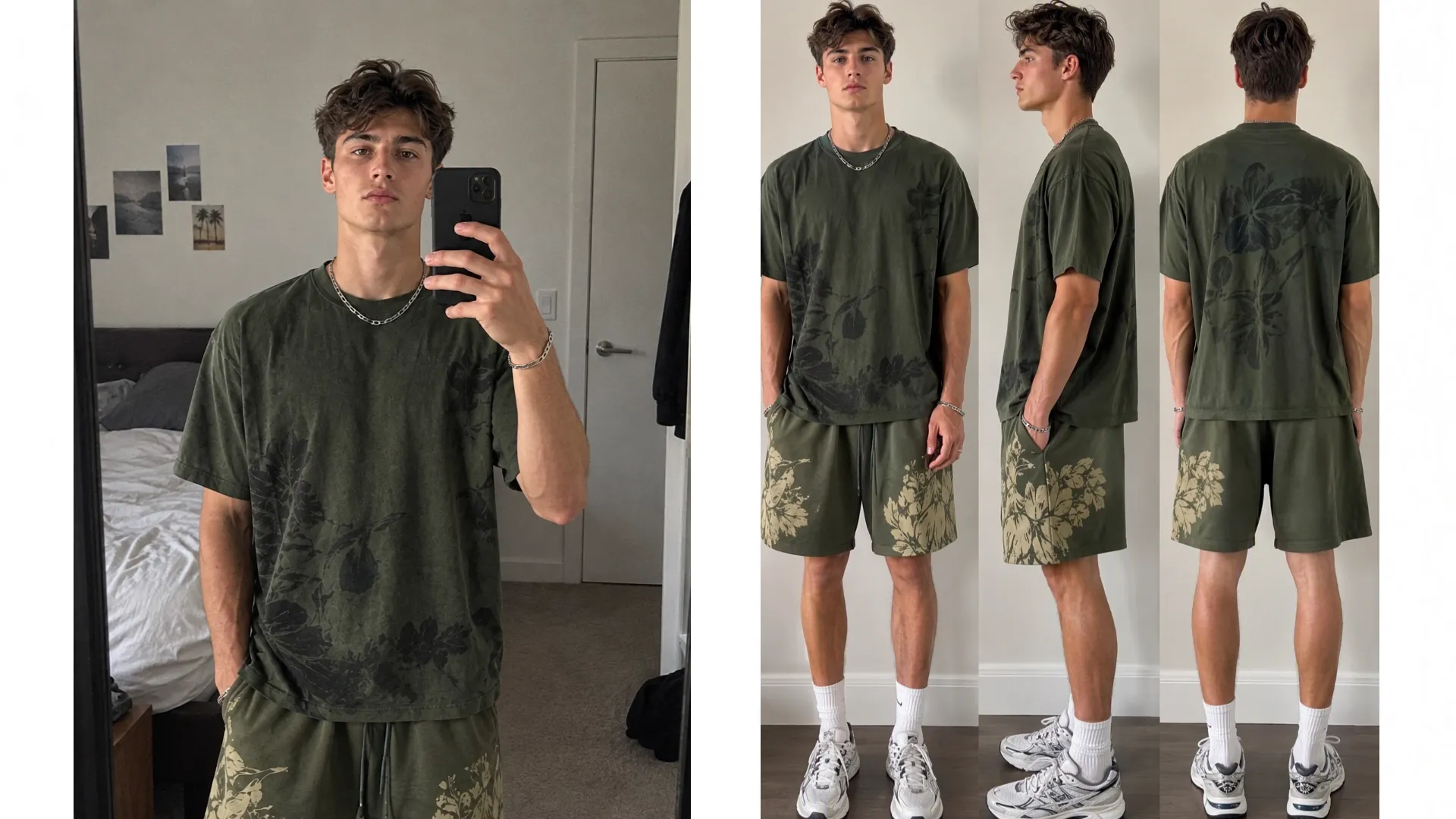
Reference Image and AI Generated Image
Step 2
Once your character three-view sheet is generated, move to Video Generation. A reference video is required for this step; you can either generate it with AI or record one yourself. Upload both the reference video and your character reference images as assets, select Reference-to-Video mode, paste your video prompt, set video duration and aspect ratio, then click Generate.

Video Generation Screen
Reference Video
Video Prompt 1:tsunami
REFERENCES:
Use the uploaded@video as the exact motion and camera reference, and the uploaded green-clothed man @image as the identity reference.
Add an immense tsunami rising beyond the city behind the rooftop and surging toward him.
TIMELINE:
0.0–2.2S:
Preserve the normal rooftop and blue daylight.
Beyond the skyline, a dark blue-gray ocean ridge becomes faintly visible, still far away and partially hidden by atmospheric haze.
The man continues his exact walk.
2.2–4.0S:
As he turns behind, the ridge rises into a towering wall of turbulent water approximately 180 meters high, spanning the complete horizon.
Its upper edge curls irregularly with white foam and wind-torn spray.
The lower portion remains correctly occluded by distant buildings.
4.0–7.0S:
At the exact moment he pivots and runs, the water wall enters the city depth behind him.
Distant buildings disappear progressively from their bases upward behind muddy water and spray, following distance order.
The wave contains heavy gray-blue water, brown sediment, white aerated foam, and large rolling surface structures, not transparent tropical water.
7.0–10.0S:
The wave advances rapidly through the skyline.
Water channels between buildings, throws broad plumes around corners, and carries small distant fragments within the flow.
Keep the rooftop, parapet, and performer intact.
The enormous mass blocks more sky, gradually cooling and reducing daylight on his face, shirt, and concrete.
Soft reflected blue-gray light rises from behind, and a moist sheen begins appearing on the parapet.
10.0–12.5S:
During his backward glance and brief imbalance, the wave towers directly behind the parapet in deep background, filling most of the horizon.
Wind-driven spray crosses the middle ground, and a few fine droplets pass in front of the lens with shallow blur.
His hair and clothing receive only subtle secondary motion compatible with his locked run.
12.5–15.0S:
The crest dominates the entire background, curling forward with dense foam and suspended spray.
Water begins spilling over distant roof levels behind the parapet, but it never reaches, covers, or changes the man before the final frame.
End just before the advancing water enters the immediate foreground.
PHYSICS AND LOOK:
Simulate enormous water mass with gravity, momentum, turbulent vortices, entrained air, sediment, and scale-dependent foam.
The wave must travel through city depth, not enlarge like a flat backdrop.
Preserve correct occlusion behind buildings and parapet.
Integrate cooling skylight, blue-gray bounce, wet reflections, and moving shadow across the man and rooftop.
Audio develops from distant low ocean rumble to thunderous water, structural groans, rushing wind, spray, footsteps, and breathing.
MASTER-VIDEO LOCK:
Treat the referenced action video as the immutable motion plate and exact timeline.
Preserve its duration, aspect ratio, frame rate, frame count, and every action at the identical moment.
Keep the performer’s position, face, hair, clothing, expression progression, head turns, arm gestures, foot contacts, stride rhythm, route, speed, balance shifts, and distance from the lens.
Preserve the source camera’s backward path, framing, perspective, parallax, handheld bounce, motion blur, autofocus, and exposure behavior.
Do not reenact, retime, loop, stabilize, replace, or improve the performance.
The person must occupy the same screen coordinates and silhouette on every corresponding frame.
IDENTITY LOCK:
Use the character image only to reinforce the identity and outfit already present in the action video.
Multiple views depict one person; generate no duplicate.
Preserve pores, hair strands, clothing seams, and natural anatomy.
No identity drift, age or body change, beauty filter, plastic skin, wardrobe mutation, extra limbs, missing hands, altered shoes, or added people.
COMPOSITING METHOD:
Transform the environment around the locked live-action plate while making the performer and foreground feel physically photographed inside the same world.
Never paste a sharp subject over a separate background.
Maintain foreground, middle-ground, distant-background, and sky depth.
Place large effects behind the performer at plausible distances and perspective scale.
Respect the existing road, buildings, trees, parapet, poles, vehicles, and horizon.
Objects react only after a visible physical influence reaches them, never beforehand.
Preserve enough original structure to prove continuous location identity.
LIGHT INTEGRATION:
Recalculate illumination on the performer frame by frame without changing identity or motion.
Preserve source daylight as the base.
Add physically motivated secondary color, bounce light, rim light, moving shadow, or reduced skylight from the correct direction and at the correct time.
Light wraps naturally across face, hair, arms, clothing folds, and legs, and matches nearby surfaces.
A bright source behind creates a believable rear highlight and reflected color; an approaching mass that blocks sky gradually reduces ambient brightness.
No cutout edge, glow halo, matte outline, mismatched color temperature, or independently exposed person.
GROUNDING AND OCCLUSION:
Preserve original foot contacts, contact shadows, and cast-shadow direction.
Environmental illumination may change shadow density gradually but cannot detach shadows or float the feet.
Effects behind the performer are correctly occluded by the body.
Fine particles cross in front only when depth and arrival time justify it, with partial transparency, lens-consistent focus, and directional blur.
They never erase the face, slice through the body, stick to the silhouette, or create an outline.
Retain the source hair and clothing motion, adding only subtle compatible secondary response.
PHYSICAL SCALE:
Use real gravity, inertia, air resistance, fluid behavior, structural mass, and propagation speed.
Distant effects have softer contrast and atmospheric perspective; nearby effects gain detail, sound, and influence.
Motion travels through scene depth rather than enlarging as a flat layer.
Light can arrive before slower pressure, material, or particle responses.
Wind, vibration, spray, dust, and fragments move from their sources with coherent direction and delayed arrival, synchronized to the locked reactions.
No weightless objects, particle loops, boiling textures, rubber buildings, miniature scale, or instant propagation.
CAMERA INTEGRATION:
Generated elements inherit the source lens and camera movement and remain anchored to world coordinates as the camera retreats.
Match lens distortion, rolling shutter, shutter blur, focus depth, sensor grain, compression, and phone dynamic range.
Brightness may trigger a brief natural auto-exposure correction without producing blank white frames.
No new angle, cutaway, aerial shot, close-up, orbit, digital zoom, speed ramp, slow motion, freeze, split screen, or transition.
AUDIO:
Preserve synchronized footsteps, breathing, and clothing sounds.
Add distance-correct environmental sound: remote low frequencies begin softly, grow in detail as the source approaches, and reflect naturally from surrounding structures.
Use directional perspective, physical delay, occlusion, and believable reverberation.
Do not bury footsteps and breathing for the whole clip.
No music, narration, dialogue, subtitles, graphics, border, or watermark.
FINAL QUALITY:
The result looks like extraordinary real footage accidentally recorded on the same consumer phone, never a VFX demonstration.
Maintain stable identity, structures, persistent particles, and continuous atmospheric or fluid motion across frames.
Avoid game graphics, glossy CGI, fake volumetric layers, cinematic grading, excessive lens flare, decorative particles, repeating patterns, morphing architecture, and oversharpening.
The scale is overwhelming, but materials, light, and integration stay observational and believable.
CONTINUITY PRIORITY:
Preserve one continuous crest and advancing water front.
No wave reset, duplicate wall, or changing direction.
AI Generated Video
Video Prompt 2: Forest Wildfire Composite
REFERENCES:
Use the uploaded @video as the exact motion and camera reference, and use the uploaded woman @image as the woman’s identity reference.
Create a vast fast-moving forest wildfire behind her, advancing along both sides of the road.
TIMELINE:
0.0–2.5S:
Preserve the sunny forest road.
In the far background, thin gray-brown smoke rises between distant trees, with a faint orange line low behind the trunks. It remains distant and naturally integrated.
2.5–4.2S:
As she looks back, the distant fire line intensifies across the forest behind her.
Individual pine crowns ignite progressively from back to front rather than simultaneously. Flames climb trunks and reach approximately 20–35 meters in the far background, bending consistently with the airflow.
4.2–7.5S:
When she covers her mouth and runs, dark smoke rolls above the tree line and spreads across the upper background.
The road itself remains open. Fine ash and sparse embers drift through the middle ground, with correct depth, size, and motion blur.
Warm orange bounce reaches the rear edges of her hair, shoulders, and gray clothing while the original sunlight still illuminates her front.
7.5–10.5S:
The fire advances along vegetation on both sides but stays behind her position.
Several nearby background crowns flare higher, producing turbulent heat distortion that affects only the scenery behind her, never warping her face or body.
Smoke reduces distant contrast and sunlight gradually becomes warmer and dimmer. Her hand-to-mouth and chest movement remain exactly as recorded.
10.5–12.5S:
During her backward glance, a tall wall of flames crosses the distant road behind her, clearly showing what she sees.
Branches shed glowing embers; small burning needles spiral in the air, but no large object flies toward her.
12.5–15.0S:
Flames occupy much of the background between the trees, with dense rolling smoke overhead and scattered ash passing through the foreground.
Keep her face readable and her route unobstructed. The fire never overtakes or touches her before the cut.
PHYSICS AND LOOK:
Use layered combustion: bright yellow-white cores, orange flame bodies, darker red edges, blackened bark, rising convective smoke, and localized crown flare-ups.
Avoid uniform wallpaper flames or decorative sparks.
Smoke must rise, fold, and drift with wind; embers follow curved buoyant paths.
Match orange reflections and reduced skylight across the woman, asphalt, rocks, and tree trunks.
Preserve her connected road shadow.
Audio grows from distant crackling to deep roaring flame, snapping branches, wind through pines, footsteps, and urgent breathing.
MASTER-VIDEO LOCK:
Treat the referenced action video as the immutable motion plate and exact timeline.
Preserve its duration, aspect ratio, frame rate, frame count, and every action at the identical moment.
Keep the performer’s position, face, hair, clothing, expression progression, head turns, arm gestures, foot contacts, stride rhythm, route, speed, balance shifts, and distance from the lens.
Preserve the source camera’s backward path, framing, perspective, parallax, handheld bounce, motion blur, autofocus, and exposure behavior.
Do not reenact, retime, loop, stabilize, replace, or improve the performance.
The person must occupy the same screen coordinates and silhouette on every corresponding frame.
IDENTITY LOCK:
Use the character image only to reinforce the identity and outfit already present in the action video.
Multiple views depict one person; generate no duplicate.
Preserve pores, hair strands, clothing seams, and natural anatomy.
No identity drift, age or body change, beauty filter, plastic skin, wardrobe mutation, extra limbs, missing hands, altered shoes, or added people.
COMPOSITING METHOD:
Transform the environment around the locked live-action plate while making the performer and foreground feel physically photographed inside the same world.
Never paste a sharp subject over a separate background.
Maintain foreground, middle-ground, distant-background, and sky depth.
Place large effects behind the performer at plausible distances and perspective scale.
Respect the existing road, buildings, trees, parapet, poles, vehicles, and horizon.
Objects react only after a visible physical influence reaches them, never beforehand.
Preserve enough original structure to prove continuous location identity.
LIGHT INTEGRATION:
Recalculate illumination on the performer frame by frame without changing identity or motion.
Preserve source daylight as the base.
Add physically motivated secondary color, bounce light, rim light, moving shadow, or reduced skylight from the correct direction and at the correct time.
Light wraps naturally across face, hair, arms, clothing folds, and legs, and matches nearby surfaces.
No cutout edge, glow halo, matte outline, mismatched color temperature, or independently exposed person.
GROUNDING AND OCCLUSION:
Preserve original foot contacts, contact shadows, and cast-shadow direction.
Environmental illumination may change shadow density gradually but cannot detach shadows or float the feet.
Effects behind the performer are correctly occluded by the body.
Fine particles cross in front only when depth and arrival time justify it, with partial transparency, lens-consistent focus, and directional blur.
They never erase the face, slice through the body, stick to the silhouette, or create an outline.
Retain the source hair and clothing motion, adding only subtle compatible secondary response.
AUDIO:
Preserve synchronized footsteps, breathing, and clothing sounds.
Add distance-correct environmental sound that begins softly and grows in detail as the fire approaches.
Use directional perspective, physical delay, occlusion, and believable reverberation.
No music, narration, dialogue, subtitles, graphics, border, or watermark.
FINAL QUALITY:
The result looks like extraordinary real footage accidentally recorded on the same consumer phone, never a VFX demonstration.
Avoid game graphics, glossy CGI, fake volumetric layers, cinematic grading, excessive lens flare, decorative particles, repeating patterns, morphing trees, and oversharpening.
CONTINUITY PRIORITY:
Maintain persistent flame fronts, smoke plumes, and ember trajectories from frame to frame.
The same burning tree remains identifiable as the camera retreats; no random reset or instant relocation.
Preserve the woman’s face, hair boundary, and body detail through haze.
AI Generated Video
Video Prompt 3: Meteor Shower Near-Miss Composite
CORE PROMPT:
Create one continuous 15.04-second horizontal 16:9 ultra-photorealistic live-action composite.
Use the uploaded motion video as the absolute motion, timing, framing, camera, and environment master, and use the uploaded man image only to preserve the man’s identity and wardrobe.
Keep every source pose, footfall, gaze, brake, duck, correction, route, camera move, plaza, and building.
Add one main meteor, a relentless distant meteor shower, and exactly four tracked near-miss fragments.
Every hard brake or evasive change is caused by a visible fragment striking the ground just vacated.
Smartphone eyewitness realism; no visible compositing.
MASTER LOCK:
Do not crop, zoom, stabilize, retime, or regenerate the source.
Keep the same coordinates, walk-to-run transition, evasive steps, observations, and approach.
Add no motion or turn; fit effects around him.
Preserve camera shake, identity, clothing, anatomy, and source blur without duplication or halo.
CAUSE-AND-EFFECT — HIGHEST PRIORITY:
Each near fragment appears 0.4–0.8 second before movement and strikes pavement occupied by him 0.2–0.4 second earlier.
Contact occurs during the dodge, never afterward.
Show approach, unchanged evasion, then impact in the vacated patch.
Each fragment is 20–40 centimeters across and produces sparks, chips, and compact dust, not a fireball.
Never hit the side toward which he moves.
GEOGRAPHY AND DENSITY:
The main body appears upper-right where his early eyes point, traveling down-left to one fixed left-central distant impact.
Four tracked near fragments explain four separate evasions.
A strikes center-right during the 5-second brake.
B appears image-left for his 6.3–6.7-second look and rightward correction.
C strikes his vacated image-left route around 9 seconds.
D descends from upper-right or mid-right and strikes his former center-right route during the 11.3–12.0-second brake, making him recover left.
His 9.75–10.55-second left-backward look targets the main cloud and is observation, not a fifth dodge.
Also create 25–35 distant fragments from 2.0 to 14.5 seconds. Introduce a new distant streak every 0.2–0.45 second, keep 3–7 visible simultaneously after 2.5 seconds, and allow no empty-sky interval longer than 0.4 second.
Most are thin and short-lived; all land far beyond the plaza, among or behind the skyline, with small remote flashes.
0.00–1.50 SECONDS:
Preserve the clean walk.
As his chin and eyes lift around 1.4–1.6 seconds, reveal a compact white-hot main body high in the upper-right directly along his gaze, with an amber sheath and turbulent tail extending upper-right.
It grows smoothly while moving down-left.
Never place it upper-left, overhead, or behind his gaze.
1.50–3.30 SECONDS:
As he runs, the main body becomes enormous but stays distant.
Its head remains in his eye line, moving from upper-right through central-right toward the left-central horizon without crossing his face or teleporting.
Tail particles lag and fade.
Warm reflections track across him, windows, and pavement.
At 2.0 seconds the distant shower begins and reaches the specified density.
Do not show A–D hovering; each enters only before its reaction.
3.30–4.30 SECONDS — MAIN IMPACT:
The main body reaches one point 1–2 kilometers beyond the left-central skyline.
A white-yellow flash expands into a colossal irregular orange fireball whose base is hidden by distant buildings.
A remote dust ring spreads and a dark column rises.
A brief left-rear pulse illuminates him and matching architecture.
Foreground structures stay intact. Keep this origin fixed.
4.30–5.70 SECONDS — NEAR-MISS A:
From 4.3 seconds, show A descending from upper-right toward the center-right of his actual running corridor, visibly converging on the pavement directly behind his legs rather than the remote background.
As he ducks and side-hops around 5.0–5.6 seconds, it strikes the precise patch he occupied 0.2–0.4 second earlier, only 1.5–2.5 meters behind and slightly image-right of his new position.
Contact occurs around 5.3–5.5 seconds during the move.
Produce one sharp spark, a 1–2-meter dust burst, and small low chips, clearly visible in the newly empty space.
No late landing or large explosion.
5.70–7.20 SECONDS — NEAR-MISS B:
B is already visible by 5.8–6.0 seconds in the upper-left-to-mid-left area.
When his head and eyes turn toward image-left around 6.3–6.7 seconds, its glowing head lies directly inside that sightline, approaching pavement beside his left route.
It strikes 2–3 meters to image-left around 6.6–6.9 seconds, just before his strongest movement away from that side.
Use a tight spark, low dust fan, and a few hot pieces skidding away from him.
Never place B on image-right, behind the skyline, or outside his gaze.
7.20–8.40 SECONDS:
Preserve his reacceleration.
The main cloud grows into a turbulent column with incandescent cavities, dark smoke, and gray dust, anchored left-central.
Nearby plumes stay low.
The distant shower remains dense, with far impacts flickering behind buildings.
Preserve depth and keep his face clear.
8.40–9.70 SECONDS — NEAR-MISS C:
C becomes visible before 8.5 seconds on image-left, descending steeply toward the path beside his left foot.
Its projected landing spot must look dangerously close to his route.
As the master shifts him toward image-right around 8.8–9.4 seconds, C hits the exact left-side patch his foot occupied 0.2–0.4 second earlier, only 1.5–2.5 meters behind-left.
Impact during the dodge, never after.
A compact spark, dust, and chips fill the space he vacates.
His leftward or downward glance lands on C while his body moves right.
Never place C behind his right shoulder or far away.
9.70–10.70 SECONDS — LEFT-BACKWARD GAZE:
As his head turns image-left, his exact sightline terminates in the huge main cloud.
Internal fire, rising stem, and rolling base occupy the continuation of his eyes.
He never looks at empty sky or image-right.
This is a brief confirmation of the main impact, not another dodge.
Keep nearby ground marks fixed and add no near impact during this look.
10.70–12.20 SECONDS — NEAR-MISS D:
D becomes visible by 10.7–11.0 seconds in the upper-right or mid-right, descending steeply toward the center-right corridor he is using.
Its trajectory must be readable before his fourth brake.
As the master spreads his arms, compresses his stride, and recovers toward image-left around 11.25–12.05 seconds, D strikes the exact center-right pavement patch occupied by his foot or torso 0.2–0.4 second earlier.
Contact occurs around 11.5–11.8 seconds, 1.5–2.5 meters behind-right of his new position, during the maneuver rather than after it.
Produce one compact white-orange spark, a low 1–2-meter dust burst, and a few pavement chips traveling away from him.
D must never hit image-left, far in the background, or an arbitrary empty spot.
Do not use a pressure wave, random stumble, or explosion to explain this fourth brake.
12.20–15.04 SECONDS:
Preserve the final straight sprint.
The main cloud towers while all four compact near-impact plumes disperse behind him.
Maintain 3–7 distant streaks at once through 14.5 seconds, with frequent remote flashes beyond the skyline, but no fifth near threat approaches him.
Dust stays behind the phone. Keep his face readable.
No added dodge, lens strike, fade, or freeze.
PHYSICS, LIGHT AND DEPTH:
Trails obey momentum, drag, and gravity.
Spark precedes dust; hot smoke rises while heavy dust stays low.
Preserve sunlight.
Main, A, B, C, and D pulses register consistently on skin, pavement, and glass.
Distant flashes cause only faint background flicker.
Shadows stay attached; effects obey depth.
Match distortion, rolling shutter, exposure, noise, compression, and blur.
CAMERA AND AUDIO:
Retain path, retreat speed, and shake.
Use brief exposure reduction during flashes and smooth recovery.
No zoom, drone, or sky pan.
Preserve footsteps, breathing, and ambience.
A–D each have a directional hiss approaching from the visible side, followed by a sharp pavement crack exactly at contact.
The main impact adds a delayed low boom, and distant impacts add layered muffled reports.
No music or dialogue.
NEGATIVE PROMPT:
No altered action or scale, wrong gaze, reaction before cause, meteor landing after the dodge, impact in an unperformed or arbitrary place, empty vacated patch, distant substitute for a near miss, upper-left initial main body, right-side main cloud, B or C on right, D on left, fewer or more than four near misses, pressure wave replacing D, empty sky after 2.5 seconds, random near impacts, hovering, giant near fireball, collapse, injury, lens debris, face-covering dust, duplicate or halo, CGI, game look, text, logo, or watermark.
PRIORITY:
Exact master motion, four cause-matched evasions, dense distant frequency, correct sightlines, seamless phone realism.
Video Prompt 4: Urban Explosion Composite
REFERENCES:
Use the uploaded motion video as the exact motion and camera reference, and the uploaded red-haired woman image as the woman’s identity reference.
Add a sequence of enormous urban explosions propagating along the closed street behind her, always following the master video’s depth and timing.
TIMELINE:
0.0–1.5S:
Preserve the ordinary closed street and natural daylight.
Nothing changes before her initial walking beat.
1.5–2.5S:
A first compact blast erupts approximately 250 meters behind her near the road’s vanishing point at the exact moment of her flinch and first backward attention.
A bright core expands into an orange fireball followed by dark gray-brown smoke.
The light reaches her and nearby facades immediately, while the slower pressure response arrives after a believable delay.
2.5–4.5S:
As she looks back and begins escaping, two larger explosions propagate forward along the distant street, each separated spatially and temporally.
They originate behind parked vehicles and street-level structures, never from her body or foreground.
Windows reflect the flashes; distant signs shake and small glass fragments fall near their sources.
4.5–7.0S:
As she accelerates, a much larger fireball rolls upward between the buildings, roughly 35–50 meters high.
A dusty pressure front moves down the street, making tree leaves, awnings, and loose paper respond in sequence.
When it reaches her depth, add a brief warm rear rim on her hair and shoulders and subtle compatible movement in her clothes without altering her locked steps.
7.0–9.5S:
Thick smoke columns expand and climb while another secondary burst flashes inside the far background.
Fire remains grounded around plausible street-level sources.
A few lightweight fragments arc behind her with gravity; none cross or strike her silhouette.
9.5–12.0S:
During her later glance, the largest rolling fire cloud fills much of the street corridor behind her.
The cloud contains incandescent orange folds, black smoke, brown dust, and glowing internal pockets, with rapidly cooling edges.
Reflected orange light travels across windows and the rear side of her body.
12.0–15.0S:
Smoke and dust chase down the street while she continues her exact run.
Keep the immediate pavement visible, her face readable, and her route clear.
The expanding cloud approaches the middle ground but never swallows her or camera before the end.
PHYSICS AND LOOK:
Every blast follows ignition, rapid gas expansion, pressure wave, rising buoyant fire, cooling smoke, and falling fragments.
Avoid identical fireballs, decorative sparks, or gasoline-like uniform flames.
Preserve buildings’ structural scale; background damage remains progressive and localized.
Match flash intensity, warm bounce, smoke shadow, and reflections on skin, hair, clothes, asphalt, windows, and parked cars.
Audio uses distance-correct cracks, delayed low booms, glass rattle, pressure thumps, footsteps, and breathing without constant clipping.
MASTER-VIDEO LOCK:
Treat the referenced action video as the immutable motion plate and exact timeline.
Preserve its duration, aspect ratio, frame rate, frame count, and every action at the identical moment.
Keep the performer’s position, face, hair, clothing, expression progression, head turns, arm gestures, foot contacts, stride rhythm, route, speed, balance shifts, and distance from the lens.
Preserve the source camera’s backward path, framing, perspective, parallax, handheld bounce, motion blur, autofocus, and exposure behavior.
Do not reenact, retime, loop, stabilize, replace, or improve the performance.
The person must occupy the same screen coordinates and silhouette on every corresponding frame.
IDENTITY LOCK:
Use the character image only to reinforce the identity and outfit already present in the action video.
Multiple views depict one person; generate no duplicate.
Preserve pores, hair strands, clothing seams, and natural anatomy.
No identity drift, age or body change, beauty filter, plastic skin, wardrobe mutation, extra limbs, missing hands, altered shoes, or added people.
COMPOSITING METHOD:
Transform the environment around the locked live-action plate while making the performer and foreground feel physically photographed inside the same world.
Never paste a sharp subject over a separate background.
Maintain foreground, middle-ground, distant-background, and sky depth.
Place large effects behind the performer at plausible distances and perspective scale.
Respect the existing road, buildings, trees, parapet, poles, vehicles, and horizon.
Objects react only after a visible physical influence reaches them, never beforehand.
Preserve enough original structure to prove continuous location identity.
LIGHT INTEGRATION:
Recalculate illumination on the performer frame by frame without changing identity or motion.
Preserve source daylight as the base.
Add physically motivated secondary color, bounce light, rim light, moving shadow, or reduced skylight from the correct direction and at the correct time.
Light wraps naturally across face, hair, arms, clothing folds, and legs, and matches nearby surfaces.
No cutout edge, glow halo, matte outline, mismatched color temperature, or independently exposed person.
GROUNDING AND OCCLUSION:
Preserve original foot contacts, contact shadows, and cast-shadow direction.
Environmental illumination may change shadow density gradually but cannot detach shadows or float the feet.
Effects behind the performer are correctly occluded by the body.
Fine particles cross in front only when depth and arrival time justify it, with partial transparency, lens-consistent focus, and directional blur.
They never erase the face, slice through the body, stick to the silhouette, or create an outline.
Retain the source hair and clothing motion, adding only subtle compatible secondary response.
CAMERA INTEGRATION:
Generated elements inherit the source lens and camera movement and remain anchored to world coordinates as the camera retreats.
Match lens distortion, rolling shutter, shutter blur, focus depth, sensor grain, compression, and phone dynamic range.
Brightness may trigger a brief natural auto-exposure correction without producing blank white frames.
No new angle, cutaway, aerial shot, close-up, orbit, digital zoom, speed ramp, slow motion, freeze, split screen, or transition.
AUDIO:
Preserve synchronized footsteps, breathing, and clothing sounds.
Add distance-correct environmental sound: remote low frequencies begin softly, grow in detail as the source approaches, and reflect naturally from surrounding structures.
Do not bury footsteps and breathing for the whole clip.
No music, narration, dialogue, subtitles, graphics, border, or watermark.
FINAL QUALITY:
The result looks like extraordinary real footage accidentally recorded on the same consumer phone, never a VFX demonstration.
Maintain stable identity, structures, persistent particles, and continuous atmospheric motion across frames.
Avoid game graphics, glossy CGI, fake volumetric layers, cinematic grading, excessive lens flare, decorative particles, repeating patterns, morphing architecture, and oversharpening.
AI Generated Video
Video Prompt 5: Tornado Road Composite
REFERENCES:
Use the uploaded motion video as the exact motion and camera reference, and the uploaded purple-clothed man image as the man’s identity reference.
Add an enormous violent tornado advancing along the same road behind him.
TIMELINE:
0.0–2.0S:
Preserve the quiet overcast road.
Far behind the man, approximately 1.5 kilometers away, a dark rotating storm base forms above the horizon and a narrow funnel begins connecting to the ground.
It remains distant enough that the man has not reacted.
2.0–4.2S:
As he turns to look behind, the funnel rapidly thickens into a massive wedge tornado approximately 600 meters wide, centered on the road’s vanishing point.
Its lower circulation pulls brown soil and dry grass into a dense rotating debris skirt.
The cloud base turns layered charcoal gray while retaining natural daylight.
4.2–7.0S:
At the exact frame he begins running, the tornado advances visibly down the road.
Dust streams across the fields toward the circulation; fence wire vibrates and grass bends in one coherent direction.
A delayed gust reaches the man as his clothing and hair show only subtle compatible motion around the locked performance.
7.0–10.0S:
During his sideways imbalance and backward glance, the wedge expands to dominate most of the distant horizon.
Rotating bands of dust wrap around its base, with a few small distant roadside fragments lifted into curved paths.
Keep all heavy debris behind him.
The sky darkens gradually and cool ambient light falls across his skin and purple clothing.
10.0–12.5S:
The outer wind reaches the foreground.
Thin dust sheets race low over the asphalt, following road perspective and briefly crossing behind his legs.
His raised forearm aligns naturally with the arriving gust.
12.5–15.0S:
The tornado becomes colossal, filling much of the background height while remaining behind him.
Its textured rotating core, inflow bands, and ground circulation remain continuous, never a flat spinning cone.
Dust approaches the lower background but does not engulf the performer or camera before the final frame.
PHYSICS AND LOOK:
Use a broad rotating condensation column with irregular internal vortices, turbulent cloud rotation, realistic dust density, and strong atmospheric depth.
Never make the funnel perfectly symmetrical or stationary.
Maintain the road surface and actor silhouette.
Add cool skylight reduction, faint warm ground bounce, and moving soft shadows consistently across the man, asphalt, and grass.
Audio progresses from distant sub-bass rumble to powerful wind, road grit, and vibrating fences, synchronized with distance.
MASTER-VIDEO LOCK:
Treat the referenced action video as the immutable motion plate and exact timeline.
Preserve its duration, aspect ratio, frame rate, frame count, and every action at the identical moment.
Keep the performer’s position, face, hair, clothing, expression progression, head turns, arm gestures, foot contacts, stride rhythm, route, speed, balance shifts, and distance from the lens.
Preserve the source camera’s backward path, framing, perspective, parallax, handheld bounce, motion blur, autofocus, and exposure behavior.
Do not reenact, retime, loop, stabilize, replace, or improve the performance.
The person must occupy the same screen coordinates and silhouette on every corresponding frame.
IDENTITY LOCK:
Use the character image only to reinforce the identity and outfit already present in the action video.
Multiple views depict one person; generate no duplicate.
Preserve pores, hair strands, clothing seams, and natural anatomy.
No identity drift, age or body change, beauty filter, plastic skin, wardrobe mutation, extra limbs, missing hands, altered shoes, or added people.
COMPOSITING METHOD:
Transform the environment around the locked live-action plate while making the performer and foreground feel physically photographed inside the same world.
Never paste a sharp subject over a separate background.
Maintain foreground, middle-ground, distant-background, and sky depth.
Place large effects behind the performer at plausible distances and perspective scale.
Respect the existing road, buildings, trees, parapet, poles, vehicles, and horizon.
Objects react only after a visible physical influence reaches them, never beforehand.
Preserve enough original structure to prove continuous location identity.
LIGHT INTEGRATION:
Recalculate illumination on the performer frame by frame without changing identity or motion.
Preserve source daylight as the base.
Add physically motivated secondary color, bounce light, rim light, moving shadow, or reduced skylight from the correct direction and at the correct time.
Light wraps naturally across face, hair, arms, clothing folds, and legs, and matches nearby surfaces.
No cutout edge, glow halo, matte outline, mismatched color temperature, or independently exposed person.
GROUNDING AND OCCLUSION:
Preserve original foot contacts, contact shadows, and cast-shadow direction.
Environmental illumination may change shadow density gradually but cannot detach shadows or float the feet.
Effects behind the performer are correctly occluded by the body.
Fine particles cross in front only when depth and arrival time justify it, with partial transparency, lens-consistent focus, and directional blur.
They never erase the face, slice through the body, stick to the silhouette, or create an outline.
Retain the source hair and clothing motion, adding only subtle compatible secondary response.
PHYSICAL SCALE:
Use real gravity, inertia, air resistance, fluid behavior, structural mass, and propagation speed.
Distant effects have softer contrast and atmospheric perspective; nearby effects gain detail, sound, and influence.
Motion travels through scene depth rather than enlarging as a flat layer.
Wind, vibration, dust, and fragments move from their sources with coherent direction and delayed arrival, synchronized to the locked reactions.
No weightless objects, particle loops, boiling textures, rubber buildings, miniature scale, or instant propagation.
CAMERA INTEGRATION:
Generated elements inherit the source lens and camera movement and remain anchored to world coordinates as the camera retreats.
Match lens distortion, rolling shutter, shutter blur, focus depth, sensor grain, compression, and phone dynamic range.
No new angle, cutaway, aerial shot, close-up, orbit, digital zoom, speed ramp, slow motion, freeze, split screen, or transition.
AUDIO:
Preserve synchronized footsteps, breathing, and clothing sounds.
Add distance-correct environmental sound: remote low frequencies begin softly, grow in detail as the tornado approaches, and reflect naturally from surrounding structures.
Do not bury footsteps and breathing for the whole clip.
No music, narration, dialogue, subtitles, graphics, border, or watermark.
FINAL QUALITY:
The result looks like extraordinary real footage accidentally recorded on the same consumer phone, never a VFX demonstration.
Maintain stable identity, structures, persistent particles, and continuous atmospheric motion across frames.
Avoid game graphics, glossy CGI, fake volumetric layers, cinematic grading, excessive lens flare, decorative particles, repeating patterns, morphing landscape, and oversharpening.
CONTINUITY PRIORITY:
Keep the tornado’s rotation direction, base position, dust skirt, and cloud connection continuous between frames.
Its apparent growth comes from forward travel through the landscape, never from a scale jump.
Preserve the man’s face and outline through every gust.
AI Generated Video
Final Summary
Create ultra-photorealistic disaster VFX videos by locking the original action footage and adding large-scale environmental effects around it. This tutorial covers wildfire, meteor shower, urban explosion, and tornado prompts built for realistic phone-camera compositing.
Each prompt focuses on preserving the performer’s motion, identity, camera path, shadows, grounding, and timing while integrating physically believable fire, smoke, debris, water, wind, light, and sound effects.